2741 W 4th Ave, Vancouver, BC V6K 1P9
+1 604-559-1666
info@karmaindianbistro.ca
Open daily from 12:00 PM
Indian food is one of the easiest cuisines in the world to eat vegan in, right up until the moment it isn't. A large part of the menu is built on vegetables, lentils and legumes with no animal product anywhere near it. And then there's a curry that looks identical to the one beside it and has cream finished through it, or a bread brushed with ghee on the way out of the tandoor.
The difference is rarely visible on the plate. Here's how to tell.

A large part of the menu is built on vegetables, lentils and legumes with no animal product anywhere near it.
Vegetarian cooking in India isn't a modern accommodation — large parts of the country have cooked this way for centuries, and the dishes were never designed around a substitute for meat. Nobody is making a vegan version of anything. The dish simply is what it is.
That means a vegan order here isn't a compromised version of the menu. There are nine vegan curries on our standing menu, alongside dals, chaats and vegetables from the tandoor.
Chana masala is chickpeas in an onion, tomato and ginger base, and nothing else. Baingan bharta is aubergine roasted until it collapses, then cooked down with spices. Most dals are lentils, aromatics and oil. Tandoori vegetables come off the skewer with a marinade that doesn't need dairy to work.
These are not the quiet corner of the menu. They're some of the dishes the kitchen is most known for.
Three things catch people out.
Paneer is cheese. Palak paneer, paneer tikka, kadai paneer — all vegetarian, none vegan. It's the single most common mix-up, because paneer reads as a tofu-like block on the plate rather than as a dairy product.
Cream and butter finish a lot of northern curries. Butter chicken is the obvious one, but korma, makhani and several others are built on dairy as a structural ingredient, not a garnish. You can't ask for it to be left out and get the same dish.
Ghee and yoghurt turn up where you wouldn't expect them. Ghee is clarified butter and it's used for richness in plenty of places. Yoghurt shows up in marinades, in raita, and as the base of a lassi.
This is the most useful thing to know, and almost nobody tells you. Northern Indian cooking leans on ghee, cream and paneer. Southern cooking leans on coconut milk and coconut oil for the same job.
So if you're ordering vegan and want the widest choice, look south first — coconut-based curries, the coastal dishes, the things built on tamarind and mustard seed rather than dairy. You're not avoiding anything there; that's simply how those dishes are made.
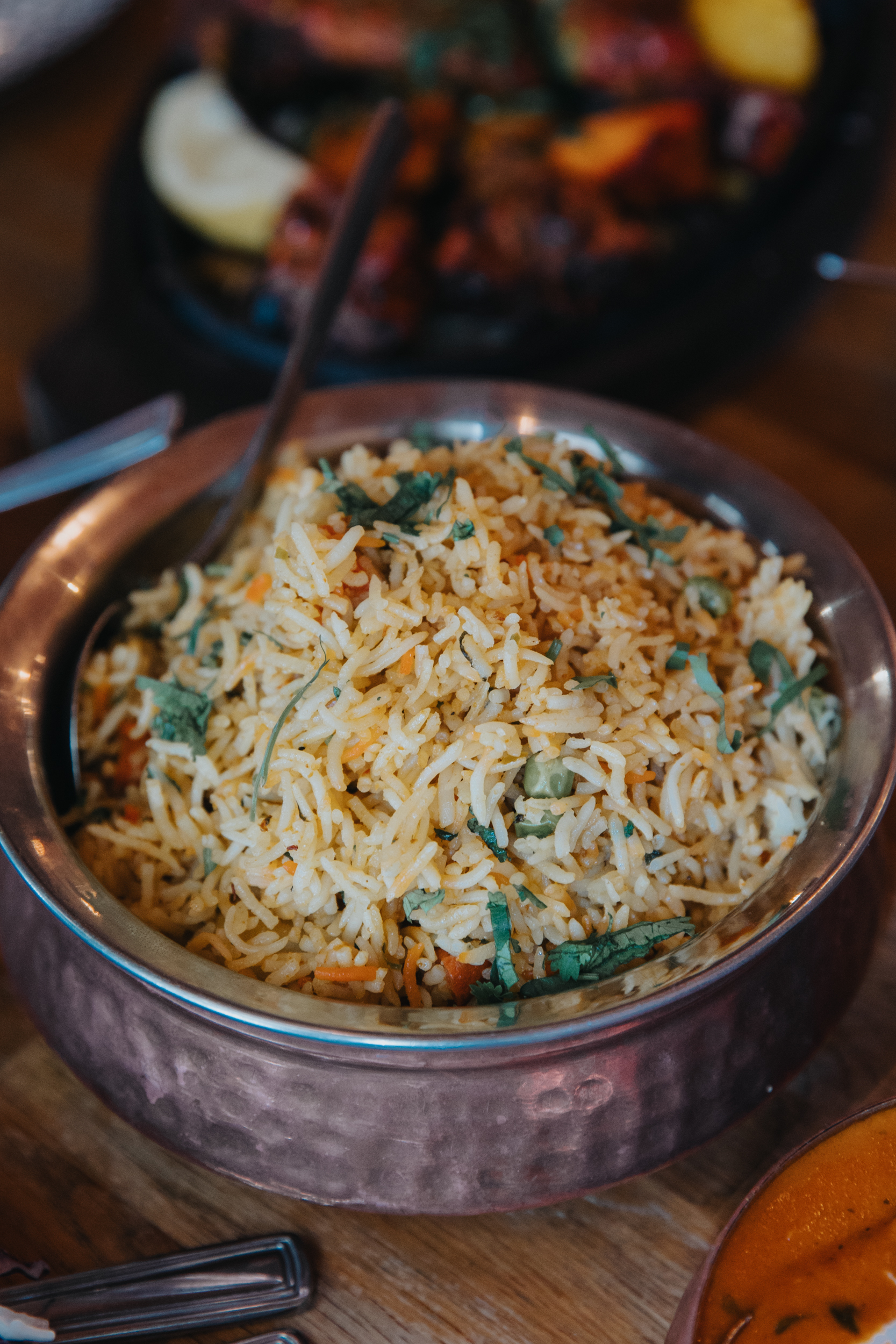
This is the one place to ask rather than assume. Naan is leavened with yoghurt or milk in most kitchens and is often brushed with ghee or butter as it comes out of the tandoor. Roti and chapati are usually just wheat, water and oil, which makes them the safer default — but preparation varies from kitchen to kitchen, including ours.
Plain basmati rice is vegan, full stop. If you want the simplest vegan meal on any Indian menu, it's a coconut or lentil curry with rice.
Ask your server about the breads. It takes ten seconds and it's the question we'd rather you asked than guessed at.
Every curry here is cooked to order at one of four spice levels, which means the kitchen genuinely can adjust things — within limits. A dish built on cream can't become a dish without cream, but plenty of others can be finished differently.
The time to raise it is when you book, or at the start of the meal, not when the food is being plated. That's especially true for a larger table, where the kitchen is cooking a lot of things at once.
How many vegan dishes are on the menu?
There are nine vegan curries on our standing menu, alongside dals, chaats, and vegetables from the tandoor.
Is paneer vegan?
No. Paneer is a fresh cheese made from milk. It's vegetarian but not vegan, and it's the most common thing people get wrong on an Indian menu.
Is naan vegan?
Not usually. Naan is typically leavened with yoghurt or milk and often brushed with ghee or butter. Ask us about the breads and we'll tell you exactly what's in each one — plain rice is always the safe choice.
Are Indian curries dairy-free?
Many are, and several aren't. Southern and coconut-based curries are usually dairy-free by design. Northern curries like korma and makhani are built on cream or butter and can't be made without it.
Can dishes be made without dairy on request?
Some can, because everything is cooked to order. Others are built on dairy and can't be. Tell your server what you need and we'll tell you honestly which is which.
Can you cater a fully vegan meal?
Yes. With nine vegan curries plus tandoori vegetables, dals and rice already on the menu, an entirely plant-based spread is straightforward rather than a special request.
Should I mention it when I book?
Please do. Note it on your reservation or call ahead, particularly for a larger table — it makes a real difference to how the kitchen plans the service.