2741 W 4th Ave, Vancouver, BC V6K 1P9
+1 604-559-1666
info@karmaindianbistro.ca
Open daily from 12:00 PM
Ninety-seven dishes across eleven sections is a wall if you have never read a menu like it. It is not as complicated as it looks - the whole thing runs on four ideas, and once you have those the ordering takes about a minute.
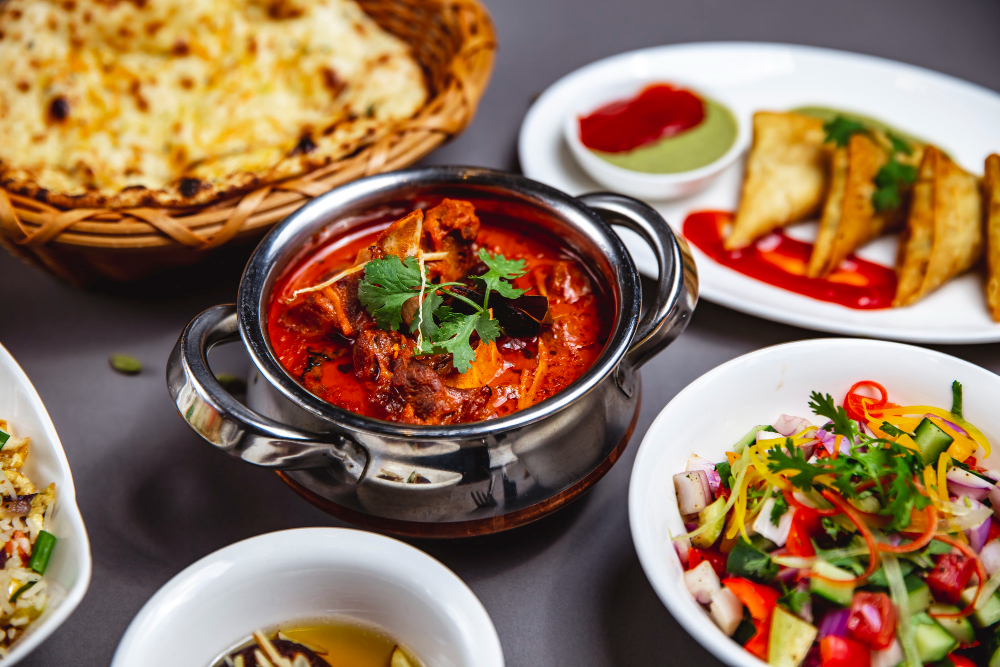
You order for a table, not for a plate. That one shift explains most of the menu.
For two people: one shared starter, two curries, one rice, one bread. Pick curries that are different from each other rather than two creamy ones. Order at medium unless you know you want more. That is about $30 to $35 each, and it is a complete meal - you do not need a dish per person, and ordering that way is the commonest first-timer mistake.
An Indian menu is not organised into courses. It is organised by how the dish was cooked and what is in it - appetizers, tandoor, then curries grouped by protein, then rice, then bread. There is no starter-main-dessert spine, because that is not how the meal works.
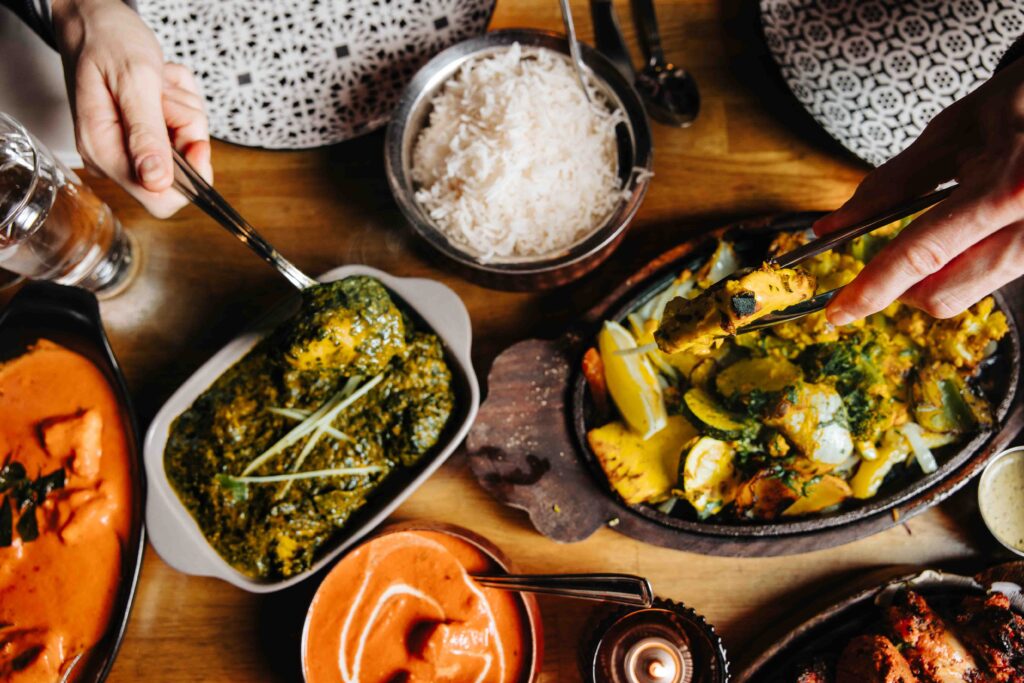
The meal works like this: several dishes arrive at roughly the same time, go in the middle, and everyone builds their own plate from them. Which means the question is never "what do I want" - it is "what should this table have between us". Once you are asking that question, eleven sections stop being intimidating and start being a shopping list.
The question is never "what do I want". It is "what should this table have between us".
A protein or vegetable in a sauce, and the centre of the meal. On our menu they are grouped by what is in them: chicken, lamb, seafood, vegan, vegetarian. The section tells you the protein; the dish name tells you the style of sauce. Butter chicken and Chicken Madras are both chicken curries and they taste nothing alike.
Meat, paneer or vegetables marinated and cooked on skewers in a clay oven, and served dry - no sauce. Tandoori chicken, chicken tikka, paneer tikka. This is the closest thing to a "grill" section, and one of these on a table gives you something with char and texture to break up all the sauces.
Either plain, as a base for the curries -basmati at $5, jeera at $7, coconut at $7 - or a biryani, which is a completely different thing: rice and meat cooked together as one finished dish, not a side. If someone at your table orders a biryani, they have ordered their whole meal, not a shared component.
Naan, roti, paratha. Torn and used to scoop, so it is a utensil as much as a food. One or two between two people is plenty.
Garlic basil naan at $5 if you want the one people come back for. Plain or butter naan at $4 if you would rather it stayed out of the way. Tandoori roti at $3 is the lighter, wholewheat option. And missi roti, made with chickpea flour, is the one gluten-free bread on the menu - everything else contains wheat.
The single most useful thing in this article. Indian portions are generous and dishes are shared, so the arithmetic is not what people expect.
2
1 starter · 2 curries · 1 rice · 1 bread
$30–35 each
4
2 starters · 3 curries · 2 rice · 2 breads · 1 raita
$28–34 each
6
3 starters · 4–5 curries · 3 rice · 3 breads · raita
$30–36 each
Note what happens as the table grows: the cost per head goes slightly down, not up, because you need proportionally fewer dishes. Four people do not need four curries. Three is plenty, and the fourth is usually the one that goes home in a box.
If you would rather everyone had their own dish, that is fine too - it works out closer to $40 to $55 a head before drinks, and there will be leftovers.
Both for two people, both from our actual menu at actual prices.
Vegetable Samosa
$10
Butter Chicken - medium
$21
Palak Paneer - mild
$19
Basmati Rice
$5
Garlic Basil Naan
$5
Total
$60 · $30 each
Two curries that are different from each other - one tomato and cream, one spinach and paneer - with something crisp to start. Nothing here will surprise anybody.
Samosa Chat
$15
Chicken Madras - medium
$21
Chana Masala - medium
$17
Coconut Rice
$7
Missi Roti
$4
Raita
$5
Total
$69 · $34.50 each
The Madras is the dish the MICHELIN Guide singled out, and the coconut rice is what they recommended with it. The chana masala is vegan, the whole table is dairy-free apart from the raita, and the raita is there to cool anything down.
Every curry here is cooked when you order it, at one of four levels - mild, medium, hot or Indian hot. Two things worth knowing on a first visit.
Order medium. Heat cannot be taken out of a finished curry, but it can always be added at the table. Medium and adjusting up is a free option; Indian hot and regretting it is not.
Set it per dish, not per table. There is no reason for everyone to eat at the spice tolerance of the most cautious person present.
We wrote about what the four levels actually mean here.
1. Ordering a dish each. The most common one. Four curries for four people is roughly a third too much food, and you lose the point of the meal, which is tasting across several things.
2. Ordering four creamy curries. Butter chicken, korma, malai kofta and paneer makhani is a lovely list and an exhausting table - it all tastes rich in the same direction. Balance one creamy with one dry, or one northern with one southern.
3. Skipping the rice. Bread alone will not get you through two curries, and rice is $5. It is the cheapest thing on the table and it does the most work.
4. Assuming vindaloo is a heat level. It is a Goan dish built on vinegar and paprika, not a rung on a ladder. Ordering it because it sounds like the hot option is how people end up with a dish they did not want.
5. Not mentioning an allergy or a diet until the food arrives. Say it when you order. Nine vegan curries and nine vegetarian ones are on the standing menu, gluten-free dishes are marked, and the kitchen would much rather know at the start.
How much Indian food should I order per person?
As a rule, one curry per two people, plus one rice and one bread per two people, and one or two starters for the table. That lands around $30 to $40 a head for food at our prices. Ordering a dish each instead pushes it closer to $40 to $55, and usually means leftovers.
What is a good first curry to order?
Butter chicken, if you want the safest possible landing - it is the mildest curry on our menu by design. If you would rather taste something you cannot get everywhere, order the Chicken Madras, which is the dish the MICHELIN Guide singled out. Either at medium.
What is the difference between a curry and a masala?
Curry is a broad English word for a spiced dish with a sauce. Masala means a spice mixture, and by extension a sauce built from one - so tikka masala is a specific dish, while curry is a category. Neither word tells you how hot something is.
Do I eat Indian food with my hands or with cutlery?
Whichever you prefer. Bread is meant to be torn and used to scoop, which most people find easier by hand, and cutlery is on every table. Nobody is watching, and there is no version of this you can get wrong.
Do I need to order an appetizer?
No, but one shared starter improves a first meal more than an extra curry does. Curries all arrive together and can blur into each other; a samosa or a plate of pakora gives the table something with a completely different texture to begin with.
What should a vegetarian order on a first visit?
Palak paneer if you eat dairy, or chana masala if you do not - one is creamy spinach with cheese, the other is chickpeas in an onion and ginger curry, and they sit at opposite ends of the vegetarian menu. Nine vegan and nine vegetarian curries are on the standing menu, so nothing needs arranging in advance.
Ninety-seven dishes, all cooked to order, open daily from noon at 2741 West 4th Avenue in Kitsilano. Tell your server it is your first time and they will happily build the table with you.