2741 W 4th Ave, Vancouver, BC V6K 1P9
+1 604-559-1666
info@karmaindianbistro.ca
Open daily from 12:00 PM
Sambar and rasam show up alongside the same dishes often enough — both are common with dosa and idli, both are tamarind-based, both are South Indian — that they get treated as roughly interchangeable by diners who haven't had a reason to pin down the difference.
You order for a table, not for a plate. That one shift explains most of the menu.
For two people: one shared starter, two curries, one rice, one bread. Pick curries that are different from each other rather than two creamy ones. Order at medium unless you know you want more. That is about $30 to $35 each, and it is a complete meal - you do not need a dish per person, and ordering that way is the commonest first-timer mistake.
Sambar and rasam show up alongside the same dishes often enough — both are common with dosa and idli, both are tamarind-based, both are South Indian — that they get treated as roughly interchangeable by diners who haven't had a reason to pin down the difference. They're genuinely not interchangeable. One is a substantial lentil stew, the other a thin, sippable soup, and they do different jobs on the same table.
The overlap between sambar and rasam is real and explains the confusion: both draw on tamarind for their characteristic sourness, both are staples of South Indian cooking specifically, and both are commonly served alongside dosa, idli, and rice. As covered in our guide to North vs South Indian food, tamarind's prominence is itself a distinctly southern trait, and these two dishes are among its most common applications.
Where they diverge is in what they're actually built from and what role they play on the plate — sambar is a substantial, filling component of the meal in its own right, while rasam is thinner and closer to a palate cleanser or digestive aid than a dish meant to be filling.
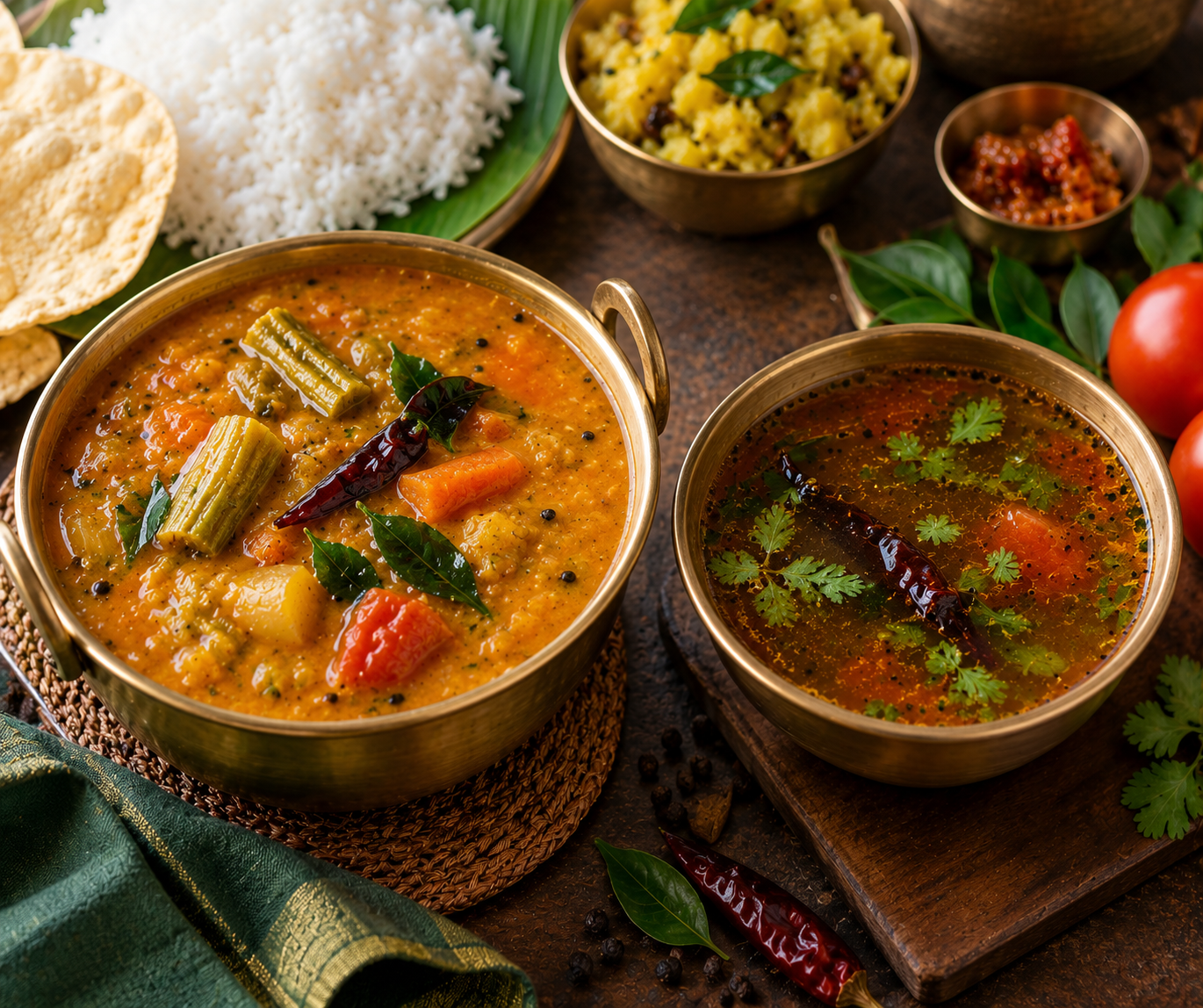
Sambar is a stew built from cooked lentils (typically toor dal), tamarind, and a mix of vegetables — common additions include drumstick (a long, fibrous vegetable), okra, eggplant, and pumpkin, though the exact vegetables vary by household and region. The lentils give sambar real body and substance, closer in weight and role to the northern dal covered elsewhere on this site than to a light soup, and it's typically finished with a tadka of mustard seed and curry leaves tempered in oil, poured over just before serving.
Because of that body, sambar functions as a genuine component of the meal rather than a side accompaniment — it's spooned generously over rice or dosa, meant to be a substantial part of what you're actually eating rather than a small flavour addition on the side.
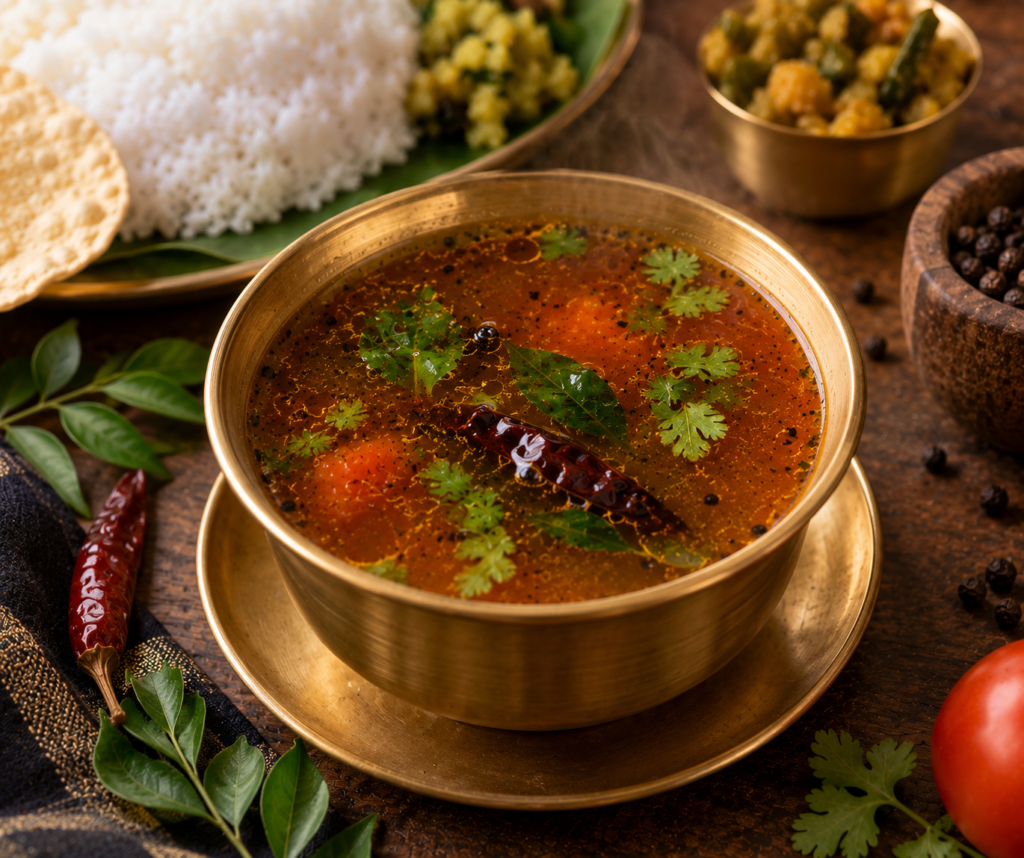
Rasam is a considerably thinner preparation — closer to a broth or a soup than a stew — built around tamarind, tomato, and a distinctive peppery, often quite spicy profile from black pepper and cumin, sometimes with a small amount of lentil water added for body but nowhere near sambar's substantial lentil-and-vegetable base. Rasam is traditionally understood to have a digestive role at the end of a meal, and its thin, sharp, peppery character supports that — it's meant to be sipped, sometimes on its own from a small cup or bowl, rather than spooned generously over rice the way sambar is.
The peppery heat in rasam is a defining feature rather than an afterthought — it's noticeably sharper and more immediately spicy than sambar's rounder, more vegetable-forward flavour, even though both dishes draw on the same tamarind base.
A South Indian meal, particularly a more traditional or complete one, will often include both dishes rather than choosing between them, since they're doing different jobs rather than competing for the same role. Sambar comes earlier in the meal or alongside the main course, mixed into rice as a substantial component. Rasam often comes later, sometimes as its own small course toward the end, functioning closer to how a digestif or a palate-cleansing soup might in another cuisine.
This is part of why seeing both on the same table isn't redundant — they're not two versions of the same idea, but two dishes built to do genuinely different things within the structure of the same meal.
While both are closely associated with dosa and idli, as covered in our guide to dosa, neither is exclusive to that pairing. Sambar is commonly eaten with plain rice as a full meal component on its own, functioning much like a dal would in a northern-style meal. Rasam is often served as its own small course within a larger South Indian meal, sometimes mixed with rice in small quantities toward the end of eating, valued as much for its digestive role as its flavour.
Our sambar is built with the traditional lentil-and-vegetable base described above, finished with a proper tadka rather than a shortcut seasoning, and served alongside our dosa. If rasam specifically is what you're after, it's worth asking directly, since availability can vary — treat it as its own distinct request rather than assuming it automatically comes paired with every South Indian dish on the menu. The current lineup is on our food menu.
What is the main difference between sambar and rasam?
Sambar is a substantial lentil and vegetable stew, thick enough to be a real component of the meal. Rasam is a much thinner, peppery, tamarind-based soup, traditionally sipped and associated with aiding digestion rather than filling you up.
Are sambar and rasam both spicy?
Rasam is generally sharper and more immediately peppery, with black pepper as a defining note. Sambar's heat is usually gentler and more rounded, coming through the vegetables and lentils rather than dominating the dish.