2741 W 4th Ave, Vancouver, BC V6K 1P9
+1 604-559-1666
info@karmaindianbistro.ca
Open daily from 12:00 PM
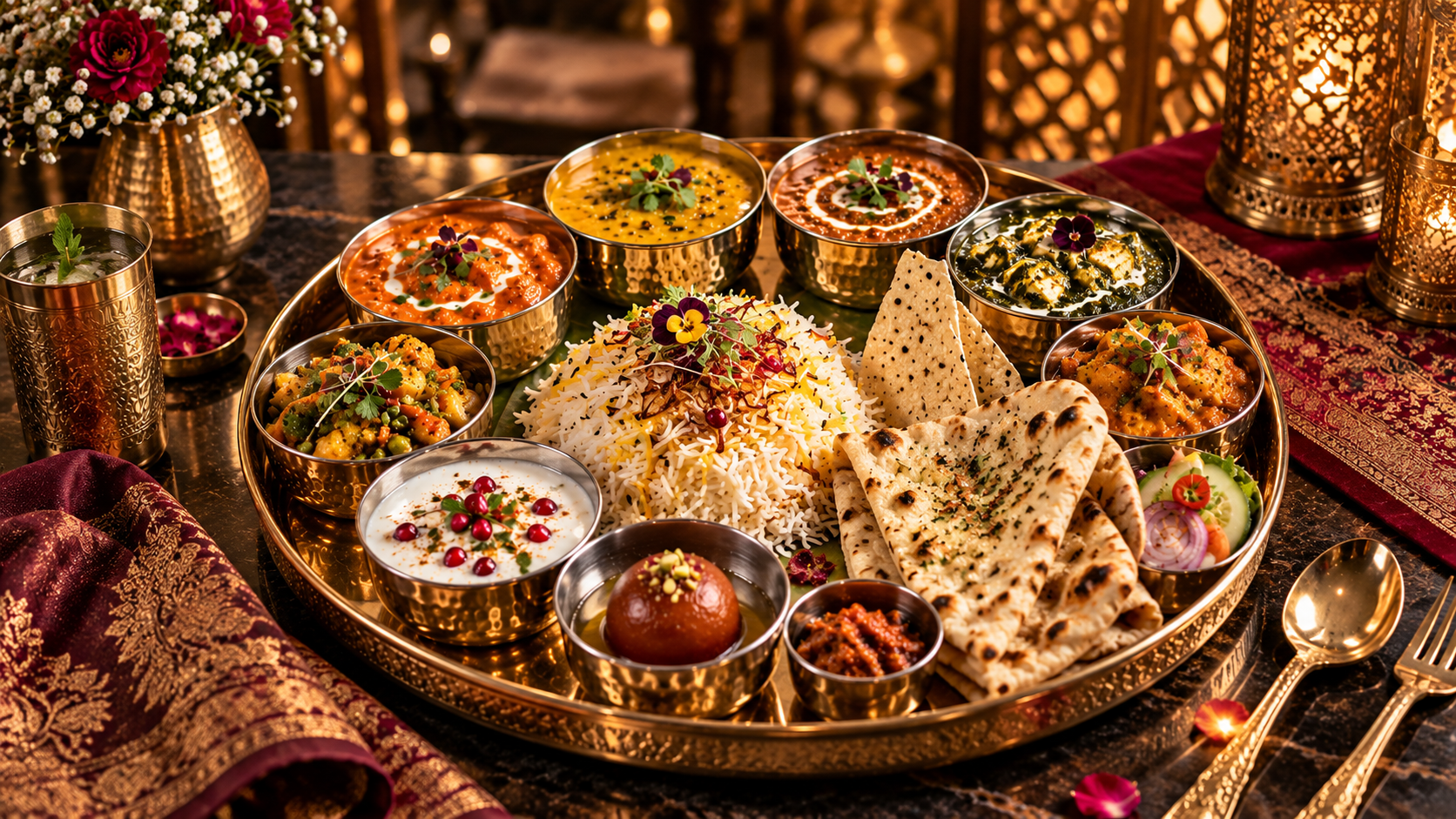
The word "thali" originally refers to the plate or tray itself — traditionally metal, divided into small compartments (or served with small individual bowls, called katori, arranged around a central portion of rice or bread) — and has come to describe the entire meal served on it.
You order for a table, not for a plate. That one shift explains most of the menu.
For two people: one shared starter, two curries, one rice, one bread. Pick curries that are different from each other rather than two creamy ones. Order at medium unless you know you want more. That is about $30 to $35 each, and it is a complete meal - you do not need a dish per person, and ordering that way is the commonest first-timer mistake.
A thali shows up on some Indian menus as a single line item, which undersells what it actually is — not one dish, but a small, complete meal arranged on a single plate or tray, built around a specific idea of balance that's genuinely different from how the rest of an Indian menu is usually ordered. As covered in our guide to first-time ordering, most Indian meals are shared across a table. A thali takes that same instinct — several dishes together rather than one main course — and compresses it onto a single plate for one person.
The word "thali" originally refers to the plate or tray itself — traditionally metal, divided into small compartments (or served with small individual bowls, called katori, arranged around a central portion of rice or bread) — and has come to describe the entire meal served on it. It's not quite the same idea as a sampler platter, even though it can look similar at a glance. A sampler is built to show off variety for its own sake. A thali is built around the idea that aproper meal should include a specific range of tastes and food groups together, in one sitting, rather than a single dominant dish with sides as an afterthought.
A typical thali includes a small portion of rice, one or two breads, a dal, one or two vegetable dishes, a raita or yoghurt-based side, a pickle or chutney, and often a small sweet to finish — essentially a compressed version of the full shared-table meal described in our guide to what to order, scaled down to individual portions and served together rather than across shared serving dishes.
The portions are intentionally small — this isn't a thali being stingy, it's the format working as designed. Because a thali is meant to deliver a range of flavours and textures in one sitting rather than filling up on a single dish, each component is portioned to be tasted properly alongside everything else rather than eaten as a full serving on its own. Many thalis, particularly in a home or a dedicated thali restaurant, come with unlimited refills of certain components (rice, dal, roti) specifically because the initial portions are meant to be a taste of the full range rather than the entire meal in one pass.
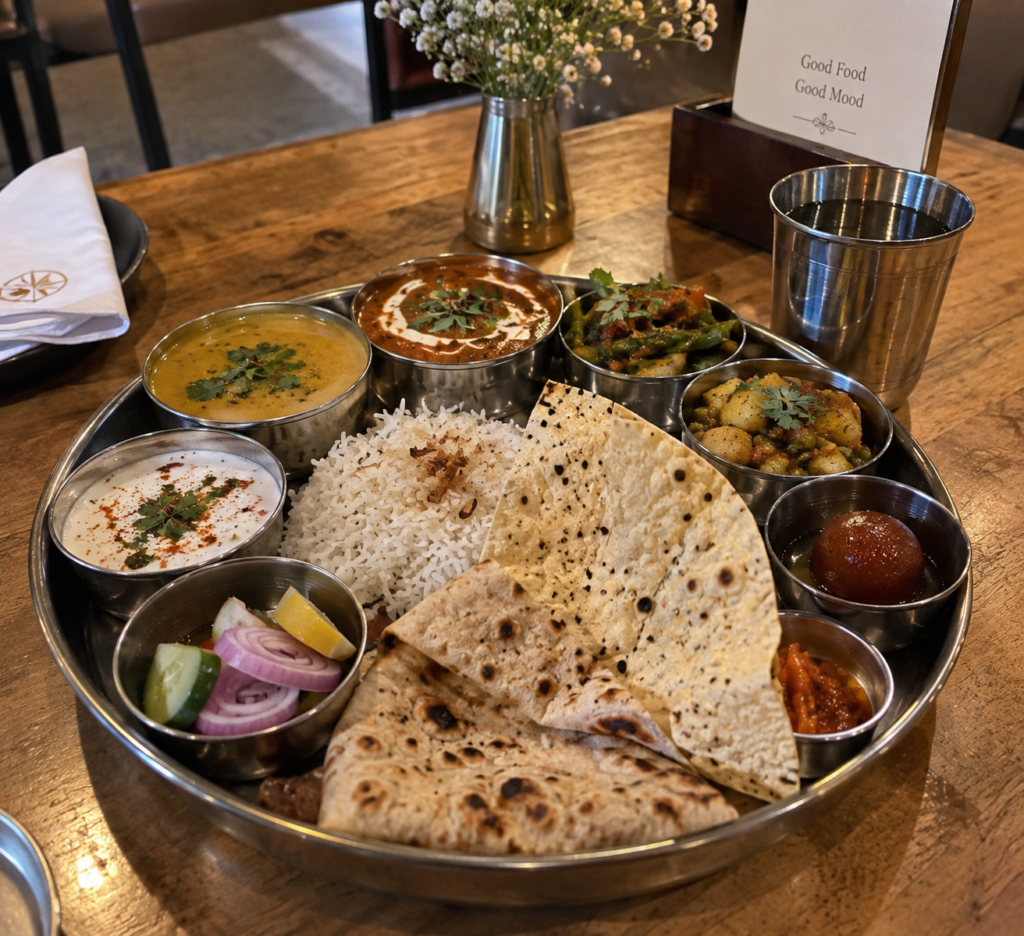
A traditional thali is built around a specific culinary philosophy — that a meal should include a representative range of tastes, not just whatever a diner happens to be craving that day. Sweet, sour, salty, bitter, astringent, and spicy are the six tastes traditionally referenced in this framework, and a well-constructed thali tries to touch on most or all of them across its different components: a sweet chutney or dessert, a sour pickle or tamarind-based dish, a salty dal or curry, a bitter note sometimes from a specific vegetable preparation, and spice running through several of the savoury components.
Chilli - fresh, dried, or ground into chilli powder - is what actually controls heat, and it's added independently of turmeric, in whatever quantity a given dish calls for. This is why, as covered in our guide to curry names, a dish's colour tells you very little about how hot it's going to be - a vibrant red or orange sauce might be turmeric- and tomato-driven with very little actual chilli, while a duller-looking sauce could be considerably hotter.
Because India's regional cuisines differ as significantly as they do — covered in more detail in our guide to North vs South Indian food — a thali's specific contents vary considerablydepending on where it's from, even though the underlying structure (rice or bread, dal, vegetables, a yoghurt side, a sweet) stays broadly consistent.
A North Indian thali typically centres on wheat bread (roti or paratha) alongside rice, richer vegetable preparations, and a dairy-based side. A South Indian thali, sometimes served on a banana leaf in more traditional settings, centres more heavily on rice, with sambar and rasam standing in for the northern-style dal, and a stronger presence of coconut and tamarind running through the vegetable dishes. A Gujarati thali, from the western state of Gujarat, is traditionally entirely vegetarian and known for balancing a notably wider range of sweet and savoury dishes within the same meal than either the northern or southern versions typically include.
None of these regional versions is more "correct" than another — they're genuinely different expressions of the same underlying idea, shaped by what each region's culinary tradition emphasizes.
The practical difference between ordering a thali and ordering a shared table of curries, as most of this site's other guides describe, comes down to scale and intention. A thali is built for one person, pre-composed by the kitchen to hit that range of tastes and food groups in a single sitting, and it's a genuinely good option for a solo diner who wants the same variety a group gets from sharing multiple dishes, without needing to order five separate items.
A shared table, by contrast, lets a group build that same variety collectively and at a larger scale, with more control over exactly which dishes make up the spread. Neither is better — a thali solves the "I'm eating alone and want variety" problem elegantly, while a shared table solves the same variety problem for a group.
Our menu is built primarily around the shared-table model described throughout this site, rather than a dedicated thali offering — most of what's on our food menu is designed to be ordered as part of a table spread rather than as a single pre-composed platter. If a thali specifically, with its particular balance of small portions and defined structure, is what you're after, it's worth asking directly whether it's available, since offerings can vary and this is exactly the kind of detail better confirmed at the table than assumed from a general guide like this one.
What is included in a typical thali?
A typical thali includes rice, one or two breads, a dal, one or two vegetable dishes, a yoghurt-based side like raita, a pickle or chutney, and often a small sweet — a compressed, single-plate version of a full shared Indian meal.
Is a thali the same as a curry meal?
Not quite. A single curry meal is usually built around one main dish. A thali is specifically composed to include a range of tastes — sweet, sour, salty, bitter, and spicy — across several small dishes served together, following a traditional idea of a balanced meal.