Naan, roti, paratha: a guide to Indian breads and what to order them with
This is a guide from the ordering side of the counter, not the baking side - what each bread actually is, how it's made, and which curry it's built to sit next to.
. Karma Indian Bistro
September 12, 2026
. 8 min read
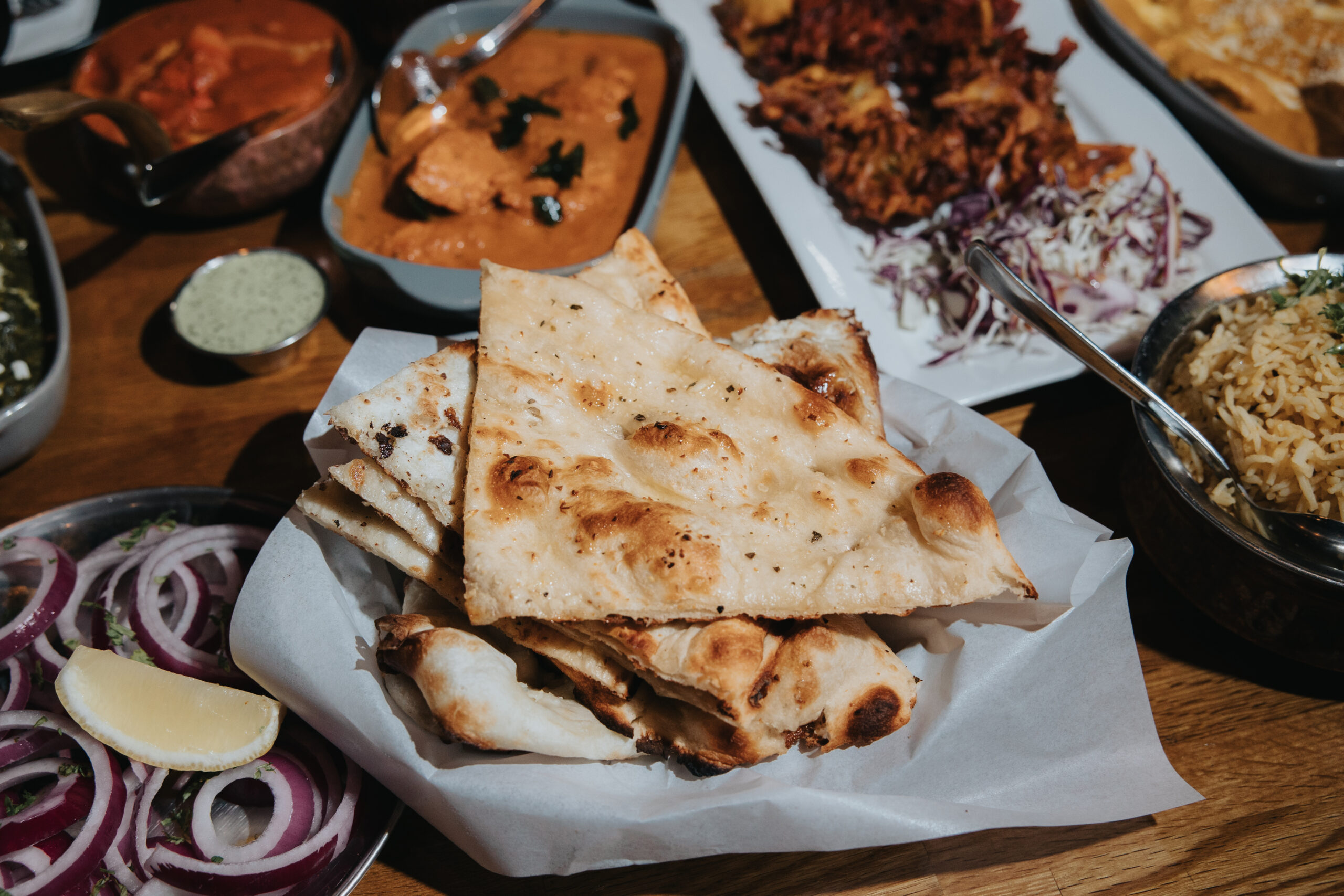
You order for a table, not for a plate. That one shift explains most of the menu.
For two people: one shared starter, two curries, one rice, one bread. Pick curries that are different from each other rather than two creamy ones. Order at medium unless you know you want more. That is about $30 to $35 each, and it is a complete meal - you do not need a dish per person, and ordering that way is the commonest first-timer mistake.
Naan, roti, paratha: a guide to Indian breads and what to order them with
Every Indian menu has a bread section, and every bread section looks roughly the same at a glance - a list of names that all sound like variations on the same thing. They're not. The breads on an Indian menu split into genuinely different families, made with different flours, cooked with different methods, and built to be eaten with different kinds of food. Once you know the one distinction that separates them, the rest of the list stops being a wall of unfamiliar words and starts being a menu you can actually order from with intention.
This is a guide from the ordering side of the counter, not the baking side - what each bread actually is, how it's made, and which curry it's built to sit next to.
The one distinction that explains everything: leavened vs unleavened
Almost every Indian bread falls into one of two families, and knowing which family a bread belongs to tells you most of what you need to know about it before it even arrives at the table.
leavened breads
Are made with a raising agent - traditionally yeast, yoghurt, or a fermented starter - which makes the dough rise before cooking. This produces a softer, airier, more pillowy bread with visible bubbles and char spots from high-heat cooking. Naan is the best-known example, and everything in the naan family (garlic naan, butter naan, cheese naan, peshwari naan) shares this same leavened base.
Unleavened breads
Use no raising agent at all - just flour, water, and sometimes a small amount of fat, rolled thin and cooked quickly on a hot surface. These breads are flatter, denser, and cook faster than their leavened counterparts. Roti and chapati are the everyday examples of this family, and they're what most households across India actually eat at home on a daily basis, in contrast to naan, which is more associated with restaurants and tandoor ovens than home kitchens.
This single distinction - risen or not risen - explains why naan feels indulgent and roti feels like an everyday staple, why naan is almost always a restaurant bread and roti is almost always a home bread, and why the two are rarely interchangeable in a dish even though both are technically "Indian bread." From here, most of the rest of the bread list is a variation on one family or the other.
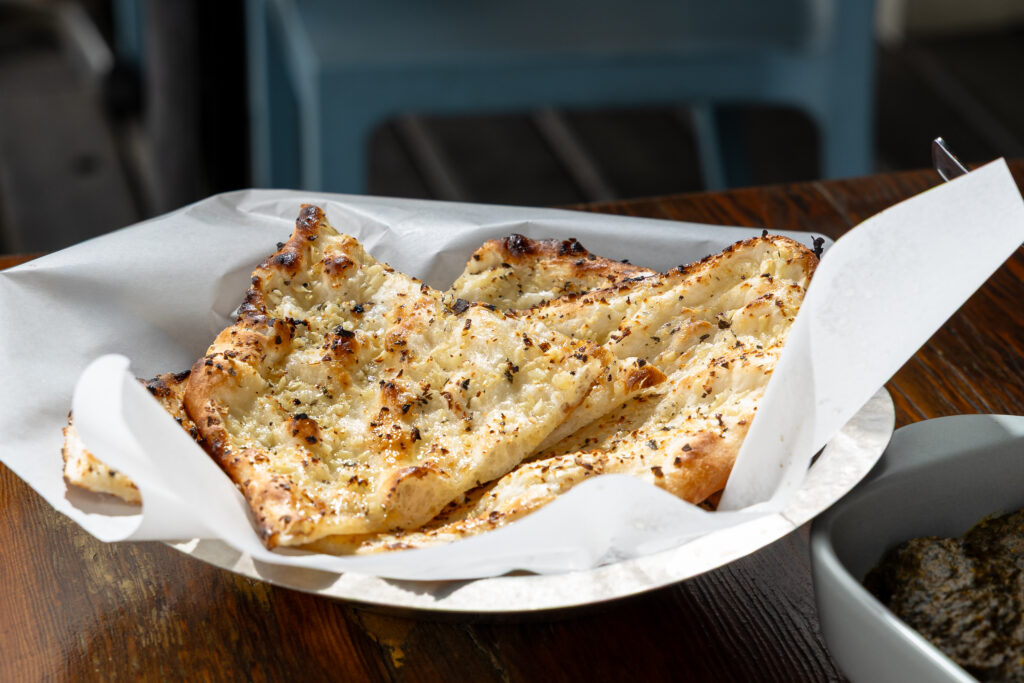
Naan and its variations - plain, garlic, butter, cheese, peshwari
Naan starts as a simple leavened dough -white flour, yeast or yoghurt, water, and a little oil - that's rolled out, stretched, and then slapped directly onto the inner wall of a tandoor, a cylindrical clay oven that reaches extremely high temperatures. The dough puffs and blisters in the intense heat, cooking in under two minutes, and the bread is peeled off the oven wall once it's done. That direct contact with the scorching clay wall is what gives naan its characteristic char spots and slightly smoky flavour - something a conventional oven can't fully replicate.
From that plain base, most naan variations are additions either worked into the dough before baking or applied to the surface after:
There's no strict rule here, but there are pairings that work better than others, largely based on how rich or thin the curry's sauce is and how much the bread needs to do.
Because naan is a restaurant bread built around a tandoor, it's genuinely difficult to make well at home, which is a large part of why naan is the bread most people associate with eating out rather than everyday cooking.
Roti and chapati: the everyday bread
Roti and chapati are, in most contexts, the same bread with two different names depending on region - a thin, unleavened, wholewheat flatbread cooked on a flat griddle called a tawa, rather than in a tandoor. The dough is simple: wholewheat flour, water, and a small amount of oil, kneaded and rested before being rolled thin and cooked quickly on both sides.
This is the bread eaten daily across most Indian households, in a way naan simply isn't - it's fast to make, requires no special equipment, and its lighter, wholewheat character is built to be a neutral base for whatever curry it's paired with rather than a flavour statement in its own right. Where naan can compete with a rich sauce for attention, roti stays out of the way and lets the curry carry the dish. This also makes roti the better everyday choice if you're eating Indian food regularly rather than as an occasional richer meal - it's lighter, generally lower in fat, and doesn't carry the same weight as a buttered or stuffed naan.
Paratha, kulcha, bhatura, papadum
Beyond naan and roti, four more breads come up often enough on Indian menus to be worth knowing individually, each with a distinct character.
Paratha is a layered, pan-fried flatbread, made by folding and rolling the dough with a thin layer of fat between the folds before cooking on a griddle - the technique creates flaky, distinct layers similar in principle to a laminated pastry. Paratha can be plain or stuffed, with popular stuffed versions including potato (aloo paratha), cauliflower (gobi paratha), or paneer. Because of the fat worked into the dough, paratha is noticeably richer and more filling than roti, and stuffed versions can be substantial enough to work as a light meal on their own.
Kulcha is a leavened bread, similar in family to naan but typically made with all-purpose flour and often served plain or with a light stuffing, commonly associated with North Indian dishes like chole (spiced chickpeas) in the pairing "chole kulcha." It's softer and slightly denser than naan, and traditionally baked rather than always cooked in a tandoor, though tandoor-baked versions are common in restaurants.
Bhatura is a leavened, deep-fried bread - light, puffed, and airy from the frying process, and almost always served as the other half of the classic pairing "chole bhature." Because it's fried rather than baked, bhatura has a different texture entirely from anything in the naan or roti families: crisp on the outside, soft and hollow inside.
Papadum is a thin, crisp wafer, not really a bread in the same sense as the others -- made from lentil flour (usually urad dal) rather than wheat, and either fried or roasted until crisp. It's typically served as a starter or a crunchy accompaniment rather than a vessel for scooping curry, often alongside chutneys or pickles at the start of a meal.
Which bread to order with which curry
There's no strict rule here, but there are pairings that work better than others, largely based on how rich or thin the curry's sauce is and how much the bread needs to do.
If you're ordering for a table sharing several curries, a mix of one naan variety and a roti or two covers most of the range - rich dishes get the naan, lighter or spicier dishes get the roti.
What we bake and how
At Karma, naan is made fresh to order and baked in a traditional tandoor, which is what produces the char and puff that separates a good naan from a flat, oven-baked imitation. The full naan range - plain, garlic, butter, cheese, and peshwari - is available, alongside roti for guests who want a lighter, everyday-style bread instead of the richer tandoor-baked option.
If you're curious about how the tandoor itself works and why it cooks bread so differently from a conventional oven, that's covered in more detail on our tandoor oven page. And if you'd rather just see the full bread list alongside the rest of the menu, it's all on our food menu.
Questions about ordering
What is the difference between naan and roti?
Naan is leavened with yeast or yoghurt, made with white flour and baked against the wall of a tandoor, so it is soft and puffed. Roti is unleavened, usually wholewheat, and cooked flat on a griddle.
What is the difference between garlic naan and butter naan?
Butter naan is a plain naan brushed with butter or ghee as it comes out of the tandoor. Garlic naan has fresh garlic worked into or onto the dough before baking.